Stinger Technology AS needed an accurate way to monitor cement returns during drilling operations. They integrated an ANB AQ² 300m pH sensor into their ROV, and used the change in seawater pH to show drillers, in real time, when cement was coming through.
- Customer
- Stinger Technology AS, Norway
- Application
- Monitoring cement returns during drilling operations
- Sensor
- ANB AQ² 300m (previously the OC300), integrated into an ROV
- Software
- Set up with anb_utils; real-time pH shown to the drillers in anb_GUI
- Result
- Quick to integrate; immediate detection of pH changes; reliable in subsea conditions without special storage or handling
Stinger Technology AS
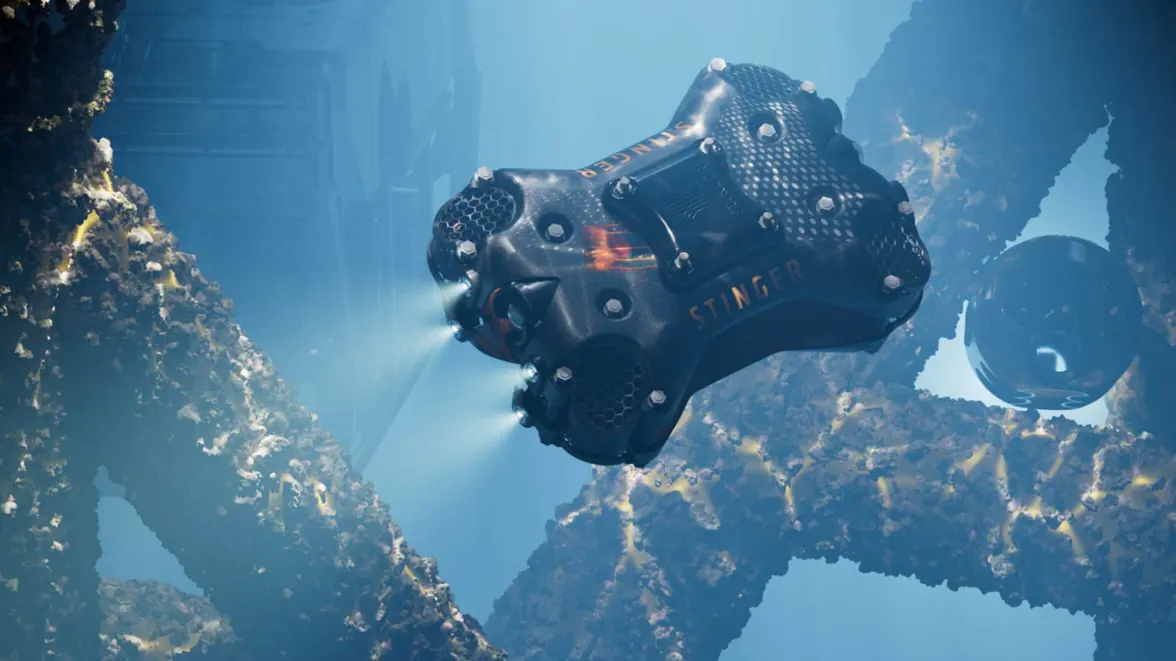
Stinger Technology AS, a Norwegian leader in subsea technology, has a long history of developing innovative solutions for the offshore industry. Their expertise in small remotely operated vehicles (ROVs) has made them a trusted partner for operators on the Norwegian Continental Shelf.
Seeing cement returns during drilling
Stinger Technology faced the challenge of accurately monitoring cement returns during drilling operations. Drillers need to know when cement is coming through so they can keep precise control of the cementing operation, and the measurement has to be made subsea, in rough conditions, from a small vehicle.
An AQ² 300m sensor on the ROV
To address this need, Stinger integrated the AQ² 300m sensor into their ROV. With its ability to measure pH in seawater, the sensor proved to be a valuable tool for detecting the presence of cement.
- Set-up: configured using ANB’s anb_utils software, and fully operational within no time.
- Display: real-time pH data shown to the drillers via anb_GUI.
Benefits in the field
- Ease of set-up. The sensor was simple to configure, greatly reducing set-up time and effort.
- Real-time monitoring. Drillers could observe pH changes instantly, allowing precise monitoring of cement returns. Immediate detection of pH changes gave them critical insights and precise control during cementing operations.
- Durability. The robust sensor withstood the rough conditions of subsea operations without requiring careful handling or storage.
- Operational success. The sensor worked flawlessly in the field, improving Stinger’s ability to monitor cement returns efficiently and reliably.
“The setup of the [AQ² 300m] was really easy using the anb_utils software, and within no time, we had it fully operational. Displaying the real-time pH data to the drillers via anb_GUI was seamless, and they were pleased to see the clear change in pH as the cement came through. The robustness of the sensor is also a huge plus—it doesn’t require careful storage, which is a real bonus in the field. The whole process was straightforward, and the sensor worked flawlessly—definitely a great tool for the job!”
Aland Samir Osman, Stinger Technology AS
What the sensor showed
Offshore, a sensor that needs careful storage, wetting caps or buffer calibration before each job is a real handicap. ANB’s sensor is fully solid-state, with no glass to break and no liquid reference, and it calibrates itself in situ. It can be stored and deployed wet or dry, which is exactly the “doesn’t require careful storage” benefit Stinger describes. For the wider comparison, see glass vs solid-state pH sensors.
The AQ² 300m is one of four depth ratings in the AQ² range (5 m, 50 m, 300 m and 1,250 m), with an accuracy of ±0.2 pH. Subsea infrastructure monitoring, deep-sea research and carbon capture and storage monitoring are among our other subsea and offshore applications.