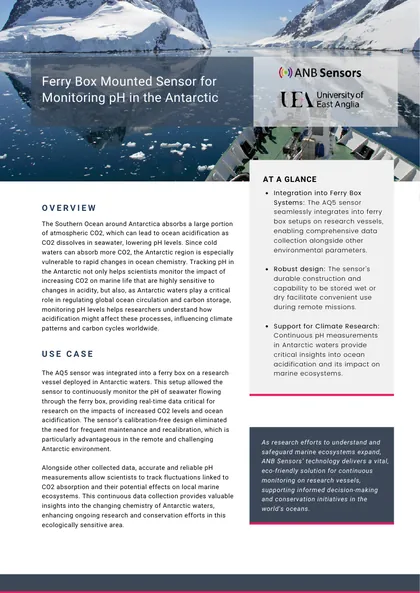
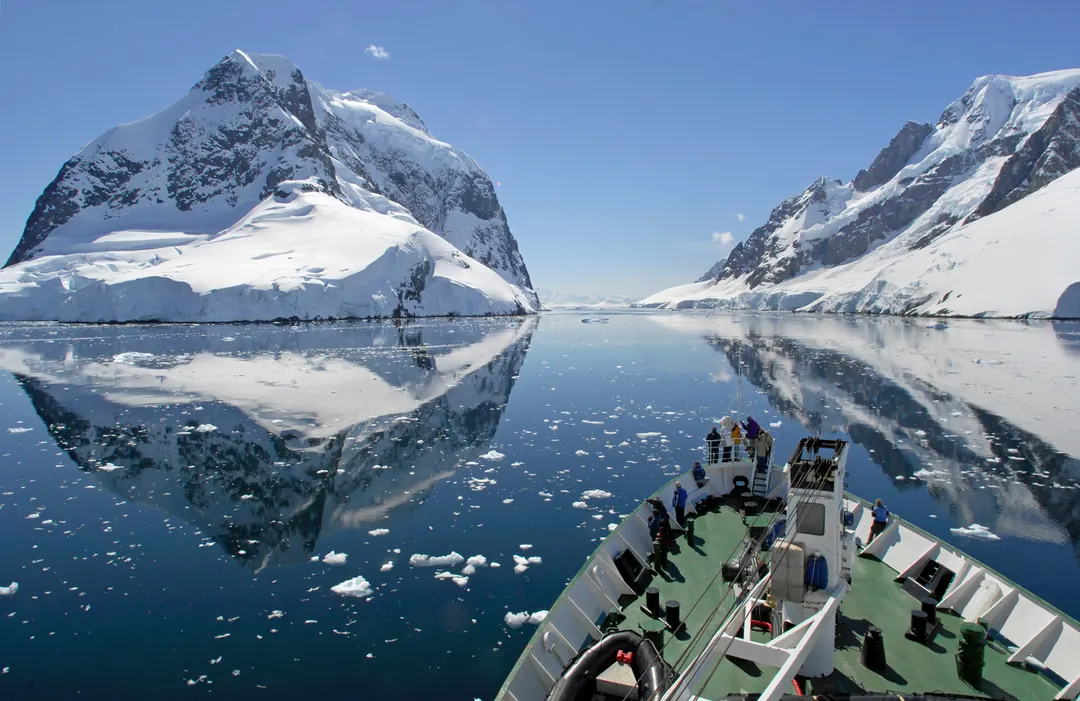
The Southern Ocean around Antarctica absorbs a large portion of atmospheric CO2, and tracking its pH is central to understanding ocean acidification. In this case study an ANB AQ² 5m sensor was integrated into a FerryBox on a research vessel in Antarctic waters, measuring the pH of seawater continuously as it flowed through the system.
- Where
- Antarctic waters, on board a research vessel
- Sensor
- ANB AQ² 5m (previously the AQ5), calibration-free
- Set-up
- Integrated into the vessel’s FerryBox, measuring seawater flowing through it alongside other environmental parameters
- Purpose
- Real-time data for research on the impacts of increased CO2 and ocean acidification
- Result
- Continuous pH monitoring with no need for frequent maintenance or recalibration; wet or dry storage made it convenient on remote missions
Measuring acidification where the ocean changes fastest
The Southern Ocean around Antarctica absorbs a large portion of atmospheric CO2. As CO2 dissolves in seawater it lowers pH, which can lead to ocean acidification. Cold waters can absorb more CO2, so the Antarctic region is especially vulnerable to rapid changes in ocean chemistry.
Tracking pH in the Antarctic helps scientists monitor the impact of increasing CO2 on marine life that is highly sensitive to changes in acidity. Antarctic waters also play a critical role in regulating global ocean circulation and carbon storage, so pH monitoring helps researchers understand how acidification might affect those processes, which influence climate patterns and carbon cycles worldwide.
The setting is remote and challenging. On a long research voyage there are few chances to maintain or recalibrate instruments, so a pH sensor that needs regular attention is a burden. For more on why pH matters in seawater, see what is pH?
An AQ² 5m sensor in the ship’s FerryBox
A FerryBox is a flow-through measuring system on board a vessel: seawater passes a set of sensors continuously, so measurements are made while the ship is under way. The AQ² 5m sensor was integrated into the FerryBox on a research vessel deployed in Antarctic waters. This set-up allowed it to monitor the pH of the seawater flowing through the FerryBox continuously, providing real-time data for research on the impacts of increased CO2 levels and ocean acidification.
The sensor integrated seamlessly into the FerryBox, so pH was collected alongside the other environmental parameters measured on board.
Continuous pH without recalibration
- No recalibration. The sensor’s calibration-free design eliminated the need for frequent maintenance and recalibration, which is particularly advantageous in the remote and challenging Antarctic environment.
- Easy integration. It fitted into the FerryBox set-up on the research vessel, enabling comprehensive data collection alongside other environmental parameters.
- Robust and easy to store. Its durable construction and the ability to be stored wet or dry made it convenient to use during remote missions.
- Data for climate research. Alongside the other data collected, accurate and reliable pH measurements allow scientists to track fluctuations linked to CO2 absorption and their potential effects on local marine ecosystems.
What the sensor showed
Continuous pH measurements in Antarctic waters provide critical insights into ocean acidification and its impact on marine ecosystems. This continuous data collection gives valuable insight into the changing chemistry of Antarctic waters, supporting ongoing research and conservation in an ecologically sensitive area.
A glass pH electrode must be kept wet and calibrated with buffers, which is awkward on a ship far from port. ANB’s sensor is fully solid-state, with no glass membrane and no liquid reference, it calibrates itself in situ, and it can be stored and deployed wet or dry, which makes it easy to handle and store on remote missions. Read how the two technologies compare in glass vs solid-state pH sensors.
The AQ² 5m is part of the AQ² range, which has an accuracy of ±0.2 pH and is available in 5 m, 50 m, 300 m and 1,250 m depth ratings. For more research-vessel and marine uses, see our applications.