pH is one of the most important parameters in aquaculture. It affects the health of fish and shellfish, the toxicity of ammonia and the performance of biofilters and water treatment. Yet conventional glass pH probes drift, need frequent recalibration, must be kept in solution at all times and can break in an active culture tank. ANB's solid-state AQ² sensor contains no glass, calibrates itself in situ and can be stored wet or dry and deployed wet or dry. In a four-month trial in flow-through seawater tanks stocked with halibut, ANB sensors ran without manual cleaning or recalibration. This page explains why pH matters on a farm, where glass probes fall short, and how to deploy and maintain a calibration-free sensor.
Aquaculture pH monitoring at a glance
- Why it matters: unsuitable or rapidly changing pH stresses fish and shellfish, reduces growth and feed efficiency and increases susceptibility to disease. It also changes ammonia toxicity and, in RAS, tracks alkalinity and nitrification.
- The problem with glass: fragile glass bulbs and liquid reference solutions drift, need frequent manual recalibration and long conditioning, must stay wet, and a broken probe is a contamination risk in the tank.
- The calibration-free alternative: AQ² compensates for reference drift in real time, inhibits biofouling during measurement and tells staff when maintenance is due through a live transducer health code.
- Upkeep: a simple abrasion of the sensor surface that takes about 30 seconds and can be done by untrained site staff, instead of a glass probe calibration that can take up to 30 minutes.
- Evidence: four months of 15-minute pH logging in flow-through seawater halibut tanks, plus laboratory agreement within ±0.2 pH of a daily calibrated glass electrode in freshwater and seawater.
Why pH matters in aquaculture
Fish and shellfish have specific pH ranges in which they grow and thrive. Prolonged exposure to unsuitable or rapidly fluctuating pH can cause physiological stress, reduce growth and feed efficiency, and increase susceptibility to disease. pH influences both the health of the cultured animals and the performance of the wider production system.
Ammonia toxicity, minerals and shellfish
pH affects the toxicity of ammonia and the availability of essential minerals. It also governs the carbonate chemistry that is particularly important for shellfish.
Alkalinity and nitrification in RAS
In recirculating aquaculture systems, pH is closely linked to alkalinity and nitrification. Biological filtration naturally consumes alkalinity, so pH can fall if alkalinity is not adequately replenished. That makes pH an important indicator of biological stability, and a useful signal for optimising biofiltration, water treatment, chemical dosing and disinfection.
Why continuous monitoring
Continuous pH monitoring gives operators early warning of changing water conditions, so they can take corrective action before water quality affects animal health, system performance or production yield. For background on the pH scale and how it is measured, see what is pH?
Why glass pH probes struggle in tanks
Glass electrodes are well established and work well on the laboratory bench. Left in a culture tank or recirculation loop for weeks, their limitations become part of daily farm routine:
- Drift. Glass probes rely on a liquid reference solution, and the reference changes over time. Drift, fouling and reference junction degradation introduce unknown offsets between calibrations, so the true accuracy of a glass electrode between calibration events is typically unknown.
- Frequent calibration. Correcting that drift means regular manual calibration with buffers. On a farm, a glass probe calibration can take up to 30 minutes and needs an extensive range of equipment and solutions. Glass probes also need long conditioning times.
- Breakage risk. A glass bulb is fragile. A breakage means a replacement probe and creates a hazardous contamination risk in an active culture tank.
- Fouling. Glass electrodes can suffer from fouling in field deployments, which adds cleaning to the calibration routine.
- Must stay wet. Glass electrodes must be kept in solution at all times. Let one dry out and it degrades, so storage caps, wetting solutions and careful handling become part of every deployment.
- No health feedback. A glass electrode gives no indication of its own condition and may keep reporting plausible values even when damaged or malfunctioning.
Calibration does not remove the uncertainty either. In ANB's laboratory testing, two commercial glass probes calibrated with the same pH 4, 7 and 10 buffers then read up to 0.24 pH apart in freshwater and 0.11 pH apart in seawater. For a fuller comparison, read glass vs solid-state pH sensors.
How the AQ² calibration-free sensor solves it
ANB's patented solid-state sensor measures pH electrochemically, without glass. A second working electrode carries a pH-independent molecule that tracks the reference electrode, and the sensor checks it before each pH measurement cycle to compensate for reference drift in real time. That is how AQ² calibrates itself in situ, with no buffers or operator intervention.
| Glass pH probe | ANB AQ² | |
|---|---|---|
| Calibration | Frequent manual calibration with buffers, up to 30 minutes each | Calibration-free; real-time drift compensation in situ |
| Breakage | Fragile glass bulb; a contamination risk in culture tanks | Solid-state design eliminates the risk of breakage |
| Storage | Must be kept in solution at all times | Stored wet or dry, deployed wet or dry |
| Fouling | Fouls glass and junction | Passive anti-fouling: locally generated biocide inhibits biofilm |
| Routine upkeep | Cleaning, recalibration, conditioning | About 30 seconds of surface abrasion, which untrained staff can do |
| Health feedback | None | Live transducer health code shows when abrasion is needed |
| Fresh and salt water | Calibrated in buffers, then moved to the sample | Measures from 0.1 to 40 ppt salinity without recalibration |
No glass in the tank
The solid-state design eliminates the risk of breakage entirely, so there is no glass to shatter in a tank of stock. The sensor is mechanically robust, which also means its surface can be abraded without risk of breakage.
Passive anti-fouling
During each measurement, the sensor produces a very low concentration of biocide local to the transducer surface. It inhibits biofilm and is quickly diluted and broken down. Together with real-time drift compensation, this removes the need for continuous cleaning and recalibration.
Maintenance only when the sensor asks for it
The only routine upkeep is a simple manual abrasion of the sensor surface with sandpaper, which takes about 30 seconds and refreshes the surface molecules. The sensor outputs a live transducer health code, a diagnostic missing from glass electrodes, which tells staff exactly when an abrasion is needed.
Stored wet or dry, deployed wet or dry
Unlike glass probes, AQ² needs no storage solution. It can sit dry on the shelf between production cycles and go straight into the tank. Built-in immersion detection suspends measurement whenever the sensor is out of the water and resumes it automatically once the sensor is immersed again.
What the evidence shows
Four months in flow-through seawater halibut tanks
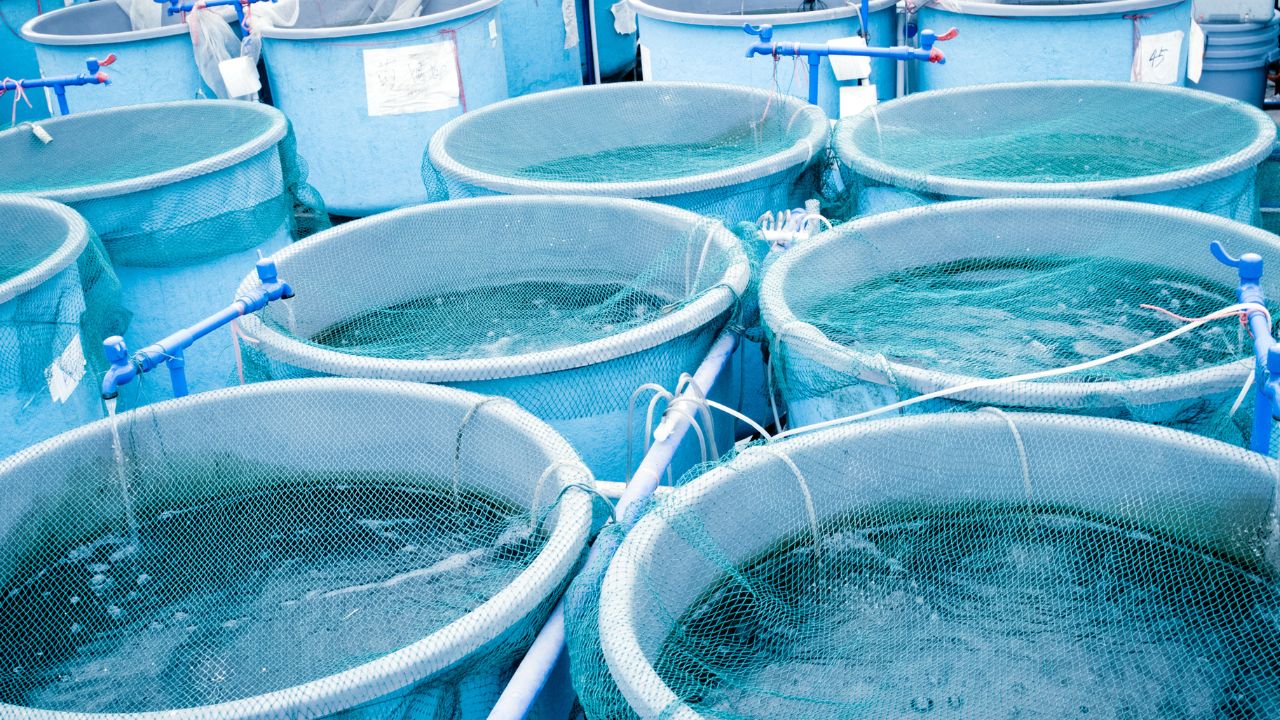
ANB sensors were installed in separate flow-through seawater tanks stocked with halibut. They were configured for autonomous deployment, logging pH every 15 minutes directly to a local PC, with live data shown in ANB's graphical user interface. Over the four-month trial:
- readings were stable and consistent with the site manager's expected values for local seawater
- the sensors needed minimal conditioning time
- they captured natural, minor changes in water chemistry, including changes of about 0.2 pH, showing that they responded to live tank conditions
- they ran without manual cleaning or recalibration throughout
- after power outages, they resumed monitoring automatically once power was restored
The white paper plots the pH and water temperature records month by month, including the power interruptions. Read the full aquaculture white paper (PDF).
Where calibration-free pH monitoring fits on a farm
The halibut trial was in flow-through seawater. ANB's aquaculture white paper also lists these application areas, from the hatchery to the effluent outfall:
| Setting | What pH monitoring supports |
|---|---|
| Hatcheries | Eggs, larvae and nursery water |
| RAS | Culture tanks and recirculation loops |
| Biofilters | Nitrification control |
| Shellfish | Carbonate chemistry |
| Marine cages | Environmental monitoring |
| Shrimp ponds | Pond-water chemistry |
| Freshwater ponds | Daily biological variation |
| Aquaponics | The balance between fish, bacteria and plants |
| Broodstock | High-value animal systems |
| Quarantine | Animal-health protection |
| Live transport | Water-quality protection |
| Water treatment and disinfection | Treatment optimisation and process control |
| Effluent | Environmental compliance |
Fresh water, brackish water and seawater
AQ² measures pH from 0.1 to 40 ppt salinity without recalibration, and all ANB sensors can operate in either fresh or salt water, so the same sensor works in a freshwater hatchery, a brackish system or a seawater tank.
Choosing a package
- AQ² on its own, with RS-232 or RS-485 and MODBUS RTU, for integration into existing loggers and control systems. It is available in 5 m, 50 m, 300 m and 1,250 m depth ratings.
- AquaLink pH, purpose-built for RAS: AQ² with a digital-to-analogue converter giving 4-20 mA and 0-5 V outputs for direct connection to existing farm monitoring.
- AquaView pH: AQ² with an integrated controller, transmitter and touchscreen display, user-configurable alarms and digital or analogue outputs.
As the white paper notes, for farm-ready installation ANB offers a ruggedised local display and controller, enabling local sensor configuration and integration with existing SCADA systems via standard 4-20 mA or digital outputs.
How to deploy and maintain an aquaculture pH sensor
Installation and start-up
- Sensors are configured at the factory and delivered with the transducer installed, ready to go within minutes of power-up.
- Allow about 30 minutes after power-up for readings to stabilise. If you are updating or redeploying a legacy sensor, stabilisation may take longer than 30 minutes.
- In continuous mode, the first measurement takes 4 minutes while the sensor runs its reference checks. Readings then follow every 5 seconds. Alternatively, set an interval between 10 and 240 minutes. The halibut trial logged every 15 minutes.
- Measurement can start on a programmable timer or automatically when the sensor is immersed.
- An integral 8 GB memory card stores in excess of 15 million data points, alongside live output to your monitoring system.
Routine maintenance
- Watch the transducer health code. When it indicates, abrade the transducer surface which takes about 30 seconds.
- How often depends on measurement frequency rather than elapsed time, because surface wear relates to the number of scans performed.
- No buffers, no calibration and no storage solution. Between deployments, store the sensor wet or dry.
- After approximately 300,000 measurements the transducer needs replacing, which can be done in the field. Videos on abrasion and transducer replacement are in the documentation.