Biofouling has long been considered a limiting factor for oceanographic studies, and one of the main obstacles to autonomous monitoring in coastal and ocean environments. In this case study, carried out with Universitat Politècnica de Catalunya, two ANB calibration-free pH sensors were deployed side by side on the OBSEA observatory in the Mediterranean Sea: one measuring, one dormant.
- Where
- OBSEA coastal observing station, Mediterranean Sea, at 20 m depth
- With
- Universitat Politècnica de Catalunya
- Set-up
- Two sensors: one scanning every 15 minutes, one left not scanning as a control
- Duration
- 6 weeks
- Result
- The scanning sensor’s transducer showed no evidence of biofouling; the dormant sensor was completely covered in biogrowth
Biofouling limits long-term ocean pH data
Measuring pH in the ocean is extremely important, and indispensable for understanding the ocean’s health. But biofouling, the rapid covering of sensors with biological growth, disrupts the long-term quality of measurements. It has long been considered a limiting factor for oceanographic studies and is recognised as one of the main obstacles to autonomous environmental monitoring in coastal and ocean environments.
The usual answer is to visit the instrument regularly to clean it, which limits how long it can be left unattended and how remote it can be. For more on how biofouling affects different pH technologies, see glass vs solid-state pH sensors.
Six weeks at 20 m on the OBSEA observatory
The sensors were deployed on the OBSEA platform in the Mediterranean Sea. The Mediterranean is recognised as a hot spot for climatic change, with significant seasonal variation in weather and biodiversity, which makes biofouling prevalent. The tests were done in collaboration with Universitat Politècnica de Catalunya.
Two sensors were deployed for 6 weeks on the coastal observing station at 20 m depth:
- Sensor 1 was set up to scan (measure) every 15 minutes.
- Sensor 2 was left not scanning, as a dormant control.
No biofouling on the scanning sensor
The results were outstanding. After 6 weeks, the transducer (the active sensing part) of the scanning sensor showed no evidence of biofouling, whereas the dormant sensor was completely covered in biogrowth.
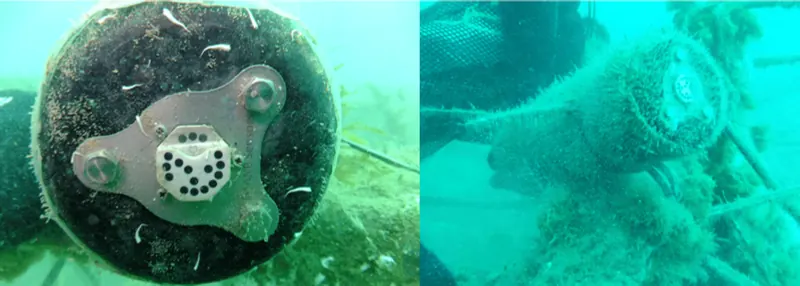
Because the two sensors sat in the same water for the same 6 weeks, the dormant control shows that the protection comes from the measurement itself.
How the sensor resists biofouling
The electrochemical method used to run the sensor produces a low concentration of hydrogen peroxide (H2O2), which inhibits the formation of bacterial biofilm on the sensing element. The hydrogen peroxide is generated locally at the surface of the sensor and is soon diluted and broken down, so it is non-hazardous to the external environment but extremely effective against biofouling.
- Longer deployments. The built-in anti-biofouling significantly reduces the build-up of organic matter, so data stays accurate and consistent over longer periods in challenging ocean environments.
- Low maintenance, high reliability. By preventing biofouling, the sensor minimises the need for frequent maintenance and cleaning, allowing uninterrupted ocean monitoring.
- Reliable in biologically active water. The anti-biofouling feature keeps performance reliable even in biologically active waters, where long-term oceanic research and environmental monitoring need dependable pH and water quality measurements.
The sensor is also fully solid-state, with no glass membrane and no liquid reference, and calibrates itself in situ. Today’s AQ² has an accuracy of ±0.2 pH and is available in 5 m, 50 m, 300 m and 1,250 m depth ratings. The same anti-biofouling behaviour matters in aquaculture tanks and on long-term coastal moorings; see all applications.