
Calibration-free is a strong claim, so we tested it. This page is the web version of ANB’s white paper Analytical Performance of the AQ²: Validation Through Laboratory Testing. It explains how the AQ² measures pH without routine user calibration, sets out how it compared with a daily calibrated laboratory-grade glass pH electrode in controlled tests, and shows what happened over 4.5 weeks in freshwater and 6 weeks in seawater. It also looks at why calibrating a glass electrode does not, on its own, guarantee an accurate reading in real waters. You can also download the white paper (PDF).
- Sensor
- AQ², ANB’s second-generation calibration-free, fully solid-state pH sensor (launched April 2026), giving pH readings every 5 seconds
- Benchmark
- A daily calibrated and verified laboratory-grade glass pH electrode, with a stated accuracy of ±0.2 pH immediately after calibration
- Laboratory result
- Through acid and base additions, the AQ² agreed with the freshly calibrated glass probe to within ±0.2 pH across the range tested, in 10 ppt water and in tap water, across several sensors
- Extended runs
- 4.5 weeks in freshwater at 1-hour measurement intervals and 6 weeks of continuous monitoring in seawater, with stable and accurate pH in both
- Glass comparison
- Two commercial glass probes calibrated identically in pH 4, 7 and 10 buffers differed by up to 0.24 pH in freshwater and 0.11 pH in seawater
How the dual working electrode architecture works
A conventional glass pH electrode develops a potential difference across a hydrated glass layer in response to hydrogen ion activity. That potential is measured against a reference electrode and follows the Nernst equation, changing predictably with pH. Glass sensors are well established, but they need frequent calibration, are susceptible to drift, must be stored wet, and can suffer from fouling, dehydration and mechanical fragility in the field. For the basics, see what is pH?
Redox-based electrochemical pH sensors work differently. They track the potential of a pH-sensitive, redox-active molecule on a working electrode in a three-electrode configuration (working, counter and reference electrodes). When a potential sweep is applied, the redox peak shifts with hydrogen ion concentration, giving a robust electrochemical proxy for pH. The reference electrode provides the baseline for that measurement. The catch is that, without a second check on the reference electrode potential, these measurements are exposed to reference electrode drift.
Two working electrodes, one shared reference
ANB’s sensor solves this with two working electrodes that share a common counter electrode and reference electrode, effectively forming two parallel three-electrode systems:
- Working electrode 1 (pH measurement) is functionalised with a pH-responsive redox-active molecule. Its redox potential shifts with hydrogen ion concentration, so pH is read from the observed peak potential.
- Working electrode 2 (reference tracker) carries a pH-independent redox molecule. Its signal reflects only the reference electrode potential.
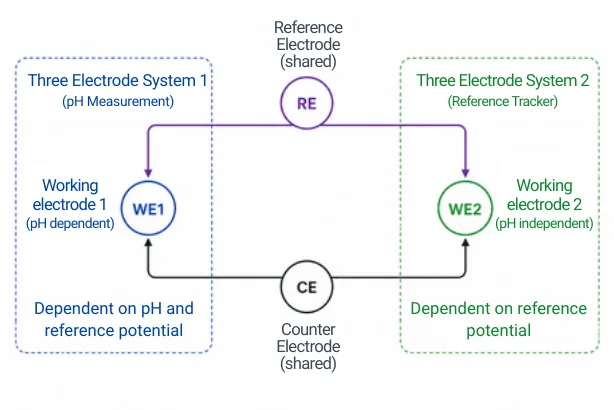
By measuring the reference tracker before each pH measurement cycle, the sensor compensates for any reference drift in real time. That is what makes stable, calibration-free pH sensing possible. The sensor is fully solid-state: there is no glass membrane and no liquid reference to maintain. For a side-by-side comparison of the two technologies, see glass vs solid-state pH sensors.
Validation against a daily calibrated glass electrode
In April 2026 we launched the second-generation calibration-free pH sensor, the AQ². It uses an updated measurement method that delivers stable pH readings every 5 seconds, for much better time resolution. A redesigned measurement and calibration framework improves accuracy across a broader range of environmental conditions, particularly in low-salinity waters. Stabilisation time has also been significantly reduced, so reliable readings come sooner after deployment or after the sensor is abraded; allow about 30 minutes for readings to stabilise.
We validated the AQ² in controlled laboratory tests against a daily calibrated and verified laboratory-grade glass pH electrode, which has a stated accuracy of ±0.2 pH units immediately after calibration. That benchmark gives a robust reference for assessing the accuracy, consistency and stability of a sensor that is not routinely calibrated by the user.
Test 1: 10 ppt water, spot checks with a calibrated glass probe
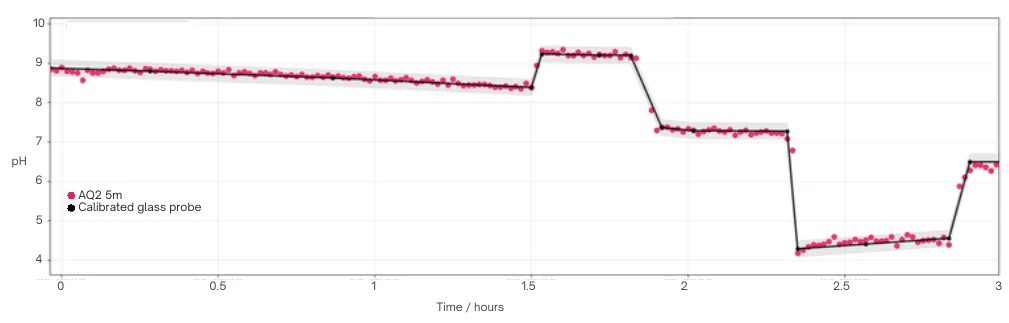
An AQ² 5m sensor was placed in 10 ppt water and the pH was changed in steps by acid and base additions. Spot measurements were taken with a freshly calibrated glass probe at discrete time points.
Test 2: several AQ² sensors in tap water
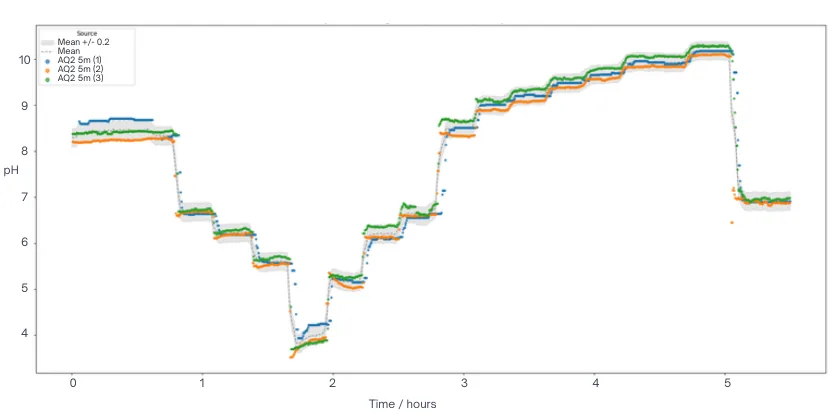
Three AQ² 5m sensors ran side by side in tap water, again with acid and base additions taking the pH up and down the scale.
Result: agreement within ±0.2 pH
The AQ² tracked dynamic pH transitions with a rapid response and stable signal. Spot measurements with the freshly calibrated glass probe showed excellent agreement with the ANB sensor, confirming ±0.2 pH accuracy across the tested pH range. This matches the ±0.2 pH accuracy in the AQ² specification.
Extended deployments: 4.5 weeks in freshwater, 6 weeks in seawater
We then evaluated the sensors over longer periods in both low- and high-salinity water:
- Freshwater: measurements at 1-hour intervals for 4.5 weeks.
- Seawater: continuous monitoring for 6 weeks.
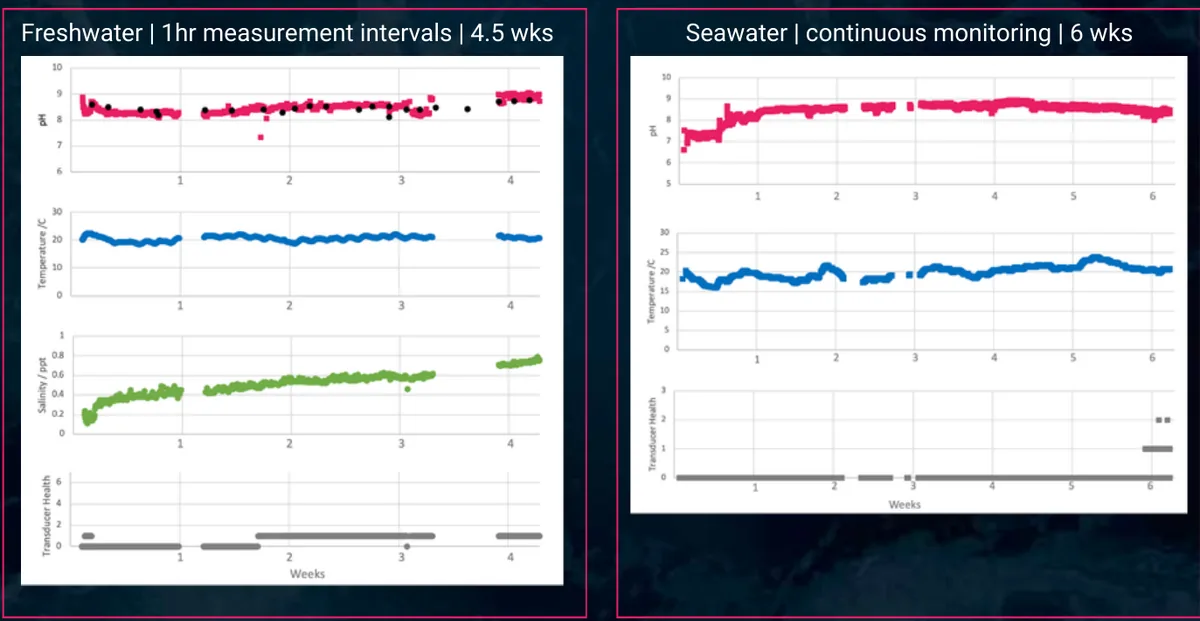
Lower-salinity water is inherently more challenging for electrochemical sensors. Reduced ionic strength lowers the solution’s conductivity, increases solution resistance and can distort electrode potentials and current responses. Despite this, the ANB sensors maintained stable and accurate pH measurements in both salinity regimes, showing that they are robust to variations in ionic strength and suitable for both marine and freshwater monitoring.
By comparison, the accuracy of a conventional glass pH electrode in the field is often uncertain unless the probe has been recently calibrated, because drift, fouling and reference junction degradation can introduce unknown offsets between calibration events. In practice, the true accuracy of a glass electrode between calibration events is typically unknown, whereas the ANB sensor continuously tracks and compensates for reference drift in situ.
Why glass electrode calibration is limiting
To illustrate the limits of calibration-based pH sensing, we calibrated two commercial glass pH probes using standard pH 4, 7 and 10 buffer solutions, then deployed them in freshwater and seawater test tanks. Despite identical calibration procedures, the two probes gave significantly different readings in both:
| Test tank | Largest difference between two identically calibrated glass probes |
|---|---|
| Freshwater | Up to 0.24 pH |
| Seawater | Up to 0.11 pH |
This variability comes from several sources inherent to glass electrode calibration: electrode ageing, reference junction effects, temperature mismatch, differences in ionic strength between buffers and real samples, and uncertainty in the buffer solutions themselves[1]. Even certified calibration buffers carry intrinsic uncertainties[2], typically ±0.02 pH for commercial technical buffers[3], and those uncertainties carry straight through into later measurements. On top of that, repeatability limitations in industrial glass-electrode pH systems often constrain achievable accuracy to about 0.1 pH units straight after calibration, even under controlled laboratory conditions[4].
Conventional buffer-based calibration therefore does not guarantee accurate or reproducible pH in real-world waters, particularly when probes move between laboratory buffers and low-buffer-capacity environmental samples. ANB’s calibration-free approach is designed to work directly in low-buffer aquatic environments and uses internal reference tracking to mitigate drift, reducing reliance on external calibration procedures that can themselves introduce systematic error.
References
- Y. C. Wu, W. F. Koch and R. A. Durst, Standard Reference Materials: Standardization of pH Measurements, NBS Special Publication 260-53 (1988 edition), National Bureau of Standards (PDF). https://nvlpubs.nist.gov/nistpubs/Legacy/SP/nbsspecialpublication260-53e1988.pdf
- Yokogawa, Basics of pH Theory (white paper). https://www.yokogawa.com/eu/library/resources/white-papers/basics-of-ph-theory
- Mettler Toledo, Comparison of pH buffer accuracy (tips and tricks). https://www.mt.com/us/en/home/library/tips-and-tricks/lab-analytical-instruments/comparison-pH-buffer-accuracy.html
- Control Global, Instrumentation: Maximize pH Response, Accuracy and Reliability. https://www.controlglobal.com/network/wireless/article/11380171/instrumentation-maximize-ph-response-accuracy-and-reliability
Tailored chemistry for low-buffer waters
A key part of ANB’s intellectual property is the design and selection of pH-responsive redox-active molecules tailored to low-buffer-capacity environments. Glass pH electrodes are optimised for, and routinely calibrated in, standard laboratory buffer solutions. ANB’s electroactive chemistry is engineered to operate in weakly buffered media, where hydrogen ion activity and proton-coupled redox equilibria more closely reflect real environmental conditions.
A common question is how accuracy is assured without calibration in standard buffers. Instead of buffer-based calibration, ANB sensors are validated and referenced using traceable electrochemical methods and comparison with calibrated glass electrodes under controlled conditions, together with internal reference tracking that compensates for reference drift in situ. This shifts calibration from periodic manual adjustment in buffers to intrinsic electrochemical self-referencing, which allows reliable long-term deployment in real-world, low-buffer waters where conventional calibration is impractical.
Immersion detection and dry tolerance
The sensor has integrated immersion detection, so it only measures when there is liquid at the sensing surface. If it detects that it is not immersed, it automatically suspends measurement and enters a low-power sleep state for five minutes before checking for immersion again. That avoids pointless measurements in air, protects the sensing surface and significantly reduces power consumption in intermittent or splash-exposed deployments.
Conventional glass pH electrodes need continuous hydration and cannot be stored or operated dry without degradation. ANB sensors can be stored wet or dry and deployed wet or dry, which opens up event-driven sampling, intermittently submerged sites and low-power remote deployments where maintenance visits are limited. Read more about a pH sensor that works wet or dry.
Maintenance: light abrasion and a built-in health indicator
Maintaining the AQ² is simple: a light abrasion of the transducer surface. After many electrochemical scans the surface molecules become less responsive, and a gentle abrasion refreshes the active surface and restores performance.
- Built-in health indicator. The sensor tells you when maintenance is needed, removing the guesswork and preventing unnoticed degradation. A glass electrode gives no feedback on its health and may keep reporting plausible values even when damaged or malfunctioning.
- Interval set by use, not time. Surface wear depends on the number of scans performed rather than elapsed time, so the maintenance interval depends on measurement frequency.
- Mechanically robust. Unlike a fragile glass probe, the surface can be abraded without risk of breakage, which suits long-term and field deployments.
What the validation shows
Laboratory testing shows that the AQ² delivers accurate, stable pH measurements without routine user calibration. Against a freshly calibrated glass electrode, it tracked rapid pH changes from acid and base additions and agreed to within ±0.2 pH across the range tested, in both 10 ppt water and tap water and across several sensors. Extended deployments of 4.5 weeks in freshwater and 6 weeks in seawater confirmed that this performance holds in both low- and high-salinity conditions.
These results come from a different way of measuring pH. The dual working electrode architecture checks the reference electrode before every reading, so drift is corrected in situ rather than building up unseen between calibrations. Our own tests show why that matters: two glass probes calibrated identically in standard buffers disagreed by up to 0.24 pH in freshwater. For glass, accuracy is known only just after calibration. For the AQ², it is maintained for the whole deployment.
With dry-tolerant immersion detection, low-power operation, a built-in health indicator and simple abrasion-based maintenance, the AQ² is well suited to long-term, remote and intermittent monitoring: coastal and ocean observation, rivers and estuaries, aquaculture and industrial water, wherever regular calibration is impractical and unknown drift is not acceptable.
Download the white paper (PDF)
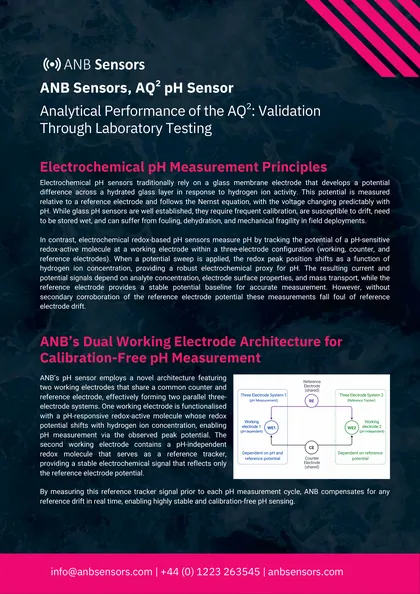
The full white paper, Analytical Performance of the AQ²: Validation Through Laboratory Testing, as a PDF (0.8 MB, 5 pages).
Download the white paper (PDF) ↓