Transducer Maintenance
Why is abrasion needed?
Over time, the sensor surface becomes less responsive. Abrasion refreshes the surface, restoring measurement performance.
How do I abrade?
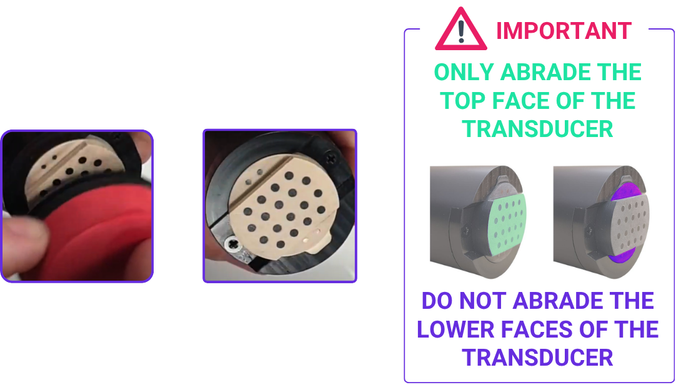
Using a wet abrasion block abrade the top face in a figure-of-eight motion for 15 secs.
When do I abrade?
The frequency of abrasion depends on how often measurements are taken. More frequent measurements require more frequent maintenance. The sensor continuously monitors its condition and provides a health indicator to guide when abrasion is required.
| Measurement Interval | Abrasion Frequency | Replacement Interval |
|---|---|---|
| Continuous | ~11 days | ~220 days (~7 months) |
| Every 15 minutes | ~52 days | ~1040 days (~2.8 years) |
| Every 60 minutes | ~208 days | ~4160 days (~11+ years) |
Values are approximate and depend on water conditions. Lower salinity may reduce intervals, while higher salinity may extend them. Please note that physical aging or other factors may limit the sensor life before abrasion limits are met.
- Be cautious to ensure the abrasion block remains horizontal to the surface
- Only abrade the transducer once housed in the sensor body
- Use a new piece of abrasion paper for each abrasion
- Wash the transducer and wipe with a clean cloth after abrasion
How to Replace the Transducer
Please watch this short video before replacing your transducer.
- Remove the 2 screws holding the Clip in place and remove the Clip
- Using the provided bottle opener – pry the sensor upwards, it will raise about 15mm
- Pull the transducer out - it is good practice to have the sensor pointing down at this stage to avoid any residual water from dripping into the sensor
- Apply a small amount of grease to the perimeter of the new transducer
- Align the new transducer with the key and push until the lower edge is flush with the main body of the sensor
- Reattach the Clip using the 2 screws provided
For further support please contact support@anbsensors.com